Part I: Policy Formulation
The process by which ridings submit resolutions for consideration at Convention has deep roots in the Party. It is one in which many members take great pride, and should not be changed lightly, both because it has in many ways served us well and because of the strong emotional attachment to it that many members have.
Here is how the present process works.
When the call for Convention is issued, individual ridings are asked to submit resolutions for consideration. These resolutions are received by a Resolutions Committee, whose job is to develop a list of priorities for discussion at Convention. Subject to an appeal process, those resolutions which get to the floor of Convention are debated. Those which are passed become Party Policy and are included in the Policy Book. All of these policy resolutions are then subject to a "sunset clause" and will be dropped from the Policy Book after a period of three Conventions unless they are reaffirmed.
The contradiction in our present policy making process is that while it gives the impression of encouraging wide grass-roots participation, the outcome of the process is so sporadic and incomprehensive that rarely is anything done with resolutions adopted at Convention. What is needed is a process that is inclusive and provides usable results.
We would like to set out the following objectives for a policy development process:
• It should result in clear, comprehensive, well informed, timely policy statements which can be readily articulated by spokespersons of the Party.
• They should enjoy broad support within the Party and speak to the aspirations of our members and the community.
A New Policy Process
A schematic diagram of the new process is shown below.
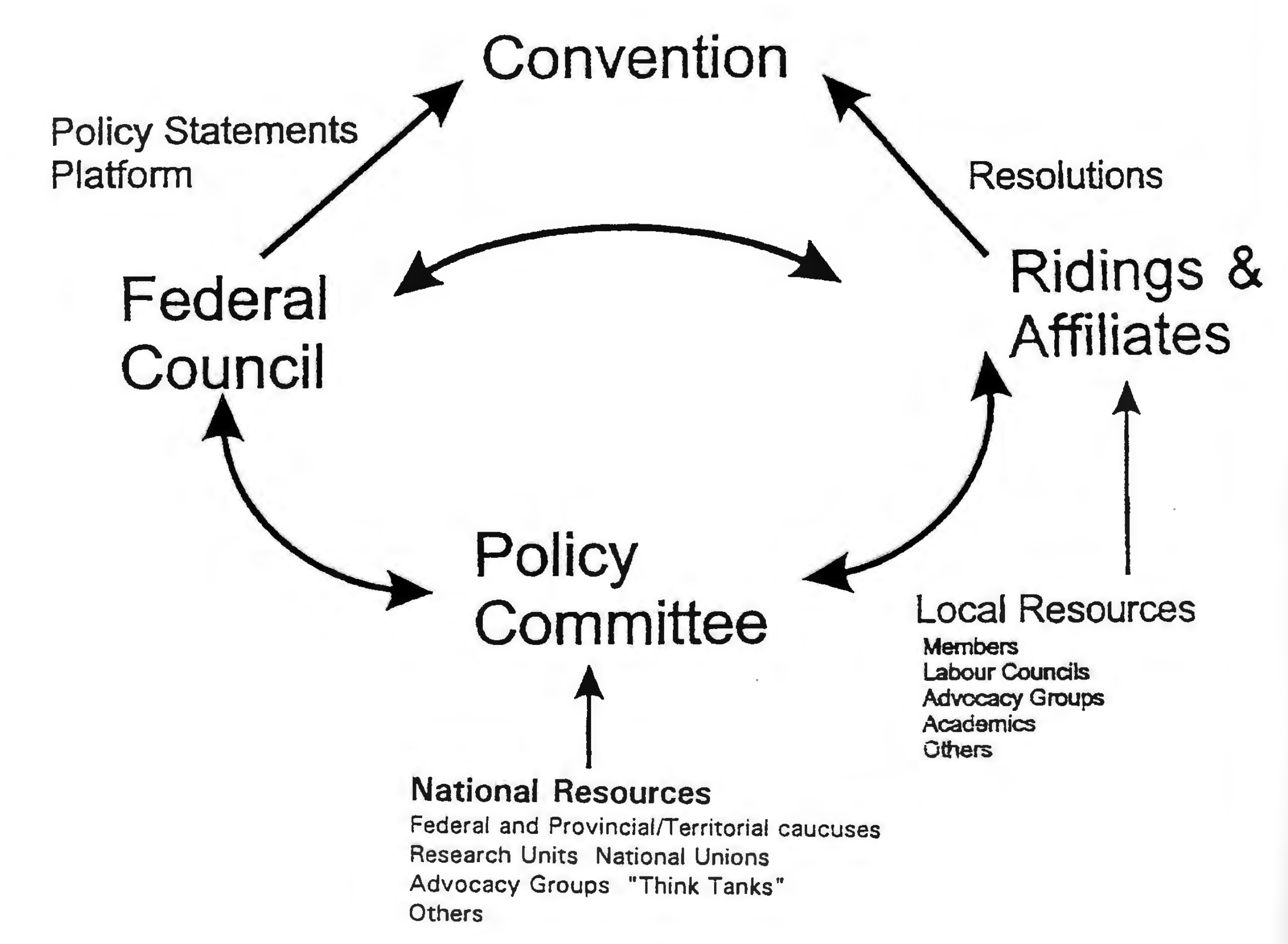 The aim is to make the process continuing, to tap all the resources available, and to have broad input from as many individual members and ridings as possible. The role of ridings in formulating policy would be strengthened, and more emphasis would be put on the policy role of Federal Council. A renewed Policy Review Committee would then support this ongoing process by stimulating its development and facilitating broad discussion and consensus building around various policy options. It would also seek out expertise and research from labour, academics, advocacy groups etc.
At any time (not just immediately prior to Convention), any riding or affiliate could take the initiative of submitting policy positions for consideration. These positions could take many forms, such as draft policy papers, draft resolutions, information provided by advocacy groups etc.
The PRC would take the positions coming forward and enlist the support of people with expertise in these areas to produce discussion papers. These papers would be circulated to ridings, elected representatives of the Party, etc., for comment and discussion.
Ridings and affiliates would be encouraged to use local resources to assist them in their deliberations. They might, for example, form discussion groups, hold symposia and consult local expertise. They would then convey the results of their work to the Policy Review Committee which would combine it with input from other ridings and other contributors. Draft versions of these policy statements would then be circulated to Federal Council, federal ridings and affiliates for consideration, and either adoption by Council or a further round of consultation with ridings/affiliates.
These policy statements would then be presented by Federal Council to Convention and either adopted or referred back for further revision or development. Most of the policy discussion time at Convention would be used for this purpose.
This broad consultation not only makes use of expertise and ideas from many sources, but it provides a healthy opportunity for building policy consensus within the Party.
Individual ridings would still be able to submit resolutions for Convention in the normal way. However, the expectation would be that most matters would have followed the procedure outlined above and have undergone broad consultation prior to Convention.
An added benefit of this process is the use of policy discussions as a means for riding associations to energize members. The old CCF study groups were very successful in providing both creative policy and a cadre of well informed activists, both of which had their roots in the kitchens of people in the community. Much of the success of the CCF in maintaining close touch with the aspirations of the community and its people can be attributed to this broadly based approach to study of policy options. It is something which we need to recapture, and we believe our proposal will move us in that direction.
There should be a clear expectation that Party spokespeople - including candidates and MPs - will be accountable for promoting and implementing Party policy. Should, for whatever reason, Caucus have to pronounce itself on a matter where the Party has yet to elaborate policy, every reasonable effort should be made to consult the Party - through the Officers, Executive or the Council - prior to doing so.
Do you like this page?